Speed Option itself is a relatively simple play that I've never been a huge fan of until this past season when I began to see it for what it is: a cheap, easy, quick way to punish the defense for poorly adjusting to a formation.
My uncle is a pretty successful shotgun coach and was really one of the pioneers of the shotgun in this part of CA. For years he was a 21 personnel I formation kind of guy, but he just couldn't get over the hump. Part of the problem was this: he was lining up 185 lb tight ends against 225 lb OLBs (specifically Andre Carter, who went on to play in the NFL). One game against Mr. Carter, they ran a sweep to his side. Outraged at their audacity, Mr. Carter reached over the 185 lb tight end and grabbed the running back and threw him to the ground. At that very moment, my uncle had what alcoholics/drug addicts refer to as a moment of clarity.
His school just wasn't going to compete with the tops of their league by running the same stuff as the tops of their league. With a population that is ~50% Asian, he perennially lacks numbers and size. He realized that if he split his TE out, he was also removing their OLB from the box, effectively trading a pawn for a knight. So, he began opening up his formations and throwing the ball more, while using his reduced box to run the ball more effectively with his undersized but well-coached offensive line.
But he began having problems with teams that started manning up on them and play Man Free, getting a numbers advantage in the box while limiting the quick game that they were fairly reliant on. He did what good football coaches do and went to an expert, Matt Logan of Corona Centennial HS in SoCal. Logan was one of the first shotgun coaches in CA and more than a bit of an expert. When he met with Logan, he came back with a lot of really great ideas and one really big piece of the puzzle: speed option.
This was before zone read was all the rage, their run game was mostly just direct handoffs with fakes by the QB. Enter speed option. What speed option allowed them to do was punish teams for manning up on their receivers and for overshifting their underneath zones toward 3x1 sets. Because of the nature of how force responsibilities tie into coverage, when teams were manned up that left their DEs responsible for playing force. When that happened, at best speed option became a real threat to create an opportunity to get a RB out in space quickly with lots of space in front of him and at worst it became a really cheap 4-5 yards for the QB to basically just fall forward to pick up. At the same time, zone teams were taking their curl/flat player and flipping him to the other side in 3x1 formations, leaving no one to play force on the backside. Same situation: the DE can't really win.
The primary reason why I'm now a fan of Speed Option and I think it merits inclusion on top of Zone Read is this: Zone Read represents two players going in opposite directions while Speed Option is two players going in the same direction. That full flow, instantly threatening the perimeter RIGHT NOW nature of the play isn't seen in shotgun offenses very often. Zone Read has a sort of rhythm to it with the snap, mesh, read, while Speed Option is just snap and gogogo, forcing a decision sooner and threatening the defense faster.
So, at the end of the day, I think it boils down to this: Speed Option is cheap to install, easy to be good at, and offers great return on the time investment. I'm honestly considering whether it's worth it to have Speed Option be an automatic check for the QB any time he gets a certain look to the weakside of the formation because I really think it's just that good for dictating how a team can adjust to you.
July 2, 2013

March 30, 2013
Shallow Cross: WHY IS HE ALWAYS OPEN???
I have a few pass concepts that I'm REALLY into and want to use as a base for an offense, namely Stick, Snag, and Shallow. There's others that are necessary like 4 Verts, but those 3 are the cats pajamas for me. The one I'm going to cover in here is Shallow, aka Shallow Cross, aka NCAA concept (because everyone in the NCAA runs it) shown here (image from Bruce Eien's page):

The basic gist of Shallow is as follows: there will always be a post route, a dig/hunt route, and a shallow crosser than runs right behind the heels of the defensive linemen at about 2-3 yds depth. From there, you can tag it up in about a thousand different ways in order to accomplish what you want. While doodling/performing thought experiments, I eventually realized that the most important thing is actually limiting how many tags I would want because SO MANY things can work off of this.
The first thing that I wanted to do was establish basic rules for the concept before branching out into tags and these are what I settled on:
1-Tagged receiver runs the Shallow. Typically this is either a slot or a TE, but can be an outside receiver, too.
2-Inside receiver opposite the Shallow runs the Dig/Hunt.
3-Outside receiver on the Shallow side runs a Fade.
4-Outside receiver opposite the Shallow side runs a Post.
5-RB runs a Shoot to the same side as the Shallow. Can be a check-release if you want it.
From there, there's certain tags that I prefer, the foremost being "Drive", where you get the Dig and Shallow coming from the same side, preferably with the Dig being run by the inside receiver like the Levels concept that Peyton Manning rode to his HOF status.

Next up is "Curl", which simply changes the Fade to a Curl route and adds a nice Curl/Flat concept on the backside. I'm actually contemplating the potential of never installing Curl/Flat as it's own concept and instead just using this tag creatively when I want to run Curl/Flat.


Scissors is a secondary tag off of Drive where your Post and Fade routes perform a quick Switch ala the Run N Shoot concept, but with a hard-set Post and Fade instead of the RNS read-as-you-go. I'd love this for Quarters coverage in particular because I'm doubting the defense's ability to handle the route exchange.
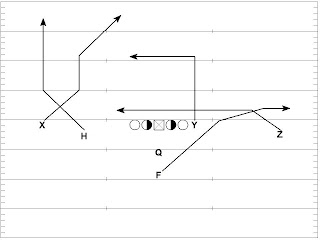
As you can see, Shallow is a terrifically variable and flexible concept and I'm just barely scratching the surface of the play. Hope I presented a good case for it's inclusion in any offense, it's a stone cold lock to be in mine.
Further Reading/Viewing:
Chris Brown's excellent article on Bobby Petrino's Shallow Cross
Brophy's Video Library comes through yet again: Noel Mazzone explains Shallow

The basic gist of Shallow is as follows: there will always be a post route, a dig/hunt route, and a shallow crosser than runs right behind the heels of the defensive linemen at about 2-3 yds depth. From there, you can tag it up in about a thousand different ways in order to accomplish what you want. While doodling/performing thought experiments, I eventually realized that the most important thing is actually limiting how many tags I would want because SO MANY things can work off of this.
The first thing that I wanted to do was establish basic rules for the concept before branching out into tags and these are what I settled on:
1-Tagged receiver runs the Shallow. Typically this is either a slot or a TE, but can be an outside receiver, too.
2-Inside receiver opposite the Shallow runs the Dig/Hunt.
3-Outside receiver on the Shallow side runs a Fade.
4-Outside receiver opposite the Shallow side runs a Post.
5-RB runs a Shoot to the same side as the Shallow. Can be a check-release if you want it.
From there, there's certain tags that I prefer, the foremost being "Drive", where you get the Dig and Shallow coming from the same side, preferably with the Dig being run by the inside receiver like the Levels concept that Peyton Manning rode to his HOF status.

"Drive"
What I like about the Drive concept is that it creates a nice high/low read on the H/C defender while also attacking vertically on the opposite side of the formation.

"Curl"
This one is lifted directly from Chris Brown and Bobby Petrino by extension, I'm just calling it Wheel. Wheel changes the RB's shoot route towards the Shallow into a Wheel in the same direction as the Shallow. The purpose of the Wheel is to clear out a Flat defender who's lurking for the Shallow or punish a Corner who's jumping onto the Post route.

"Wheel"
Scissors is a secondary tag off of Drive where your Post and Fade routes perform a quick Switch ala the Run N Shoot concept, but with a hard-set Post and Fade instead of the RNS read-as-you-go. I'd love this for Quarters coverage in particular because I'm doubting the defense's ability to handle the route exchange.
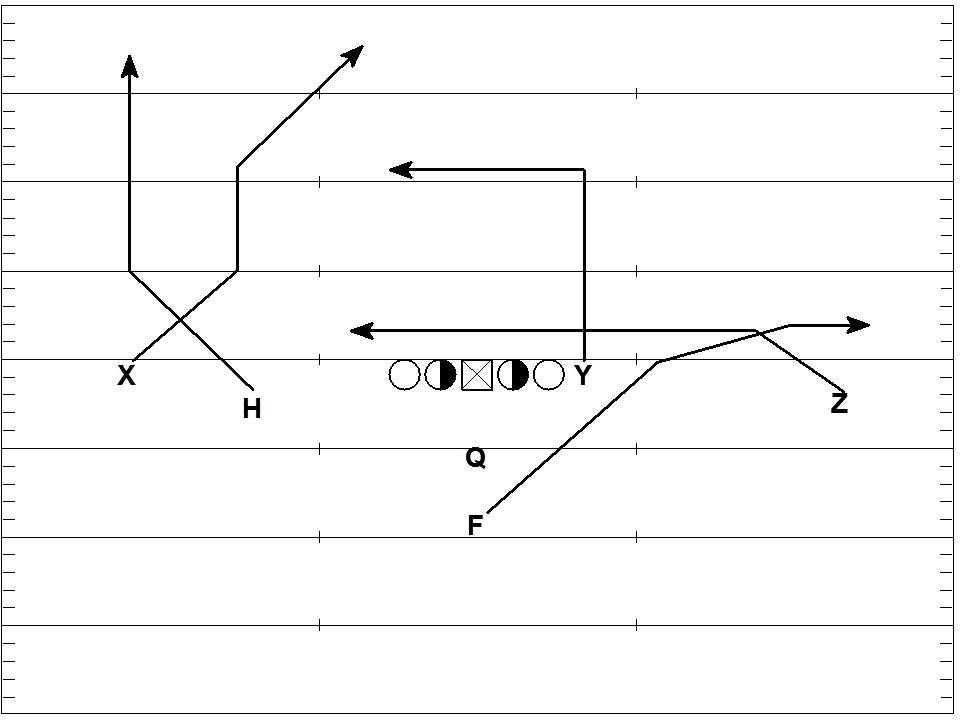
"Switch"
As you can see, Shallow is a terrifically variable and flexible concept and I'm just barely scratching the surface of the play. Hope I presented a good case for it's inclusion in any offense, it's a stone cold lock to be in mine.
Further Reading/Viewing:
Chris Brown's excellent article on Bobby Petrino's Shallow Cross
Brophy's Video Library comes through yet again: Noel Mazzone explains Shallow
March 28, 2013
Tackling Circuits: My stance
This is inspired by a recent discussion on Coach Huey about tackling circuits and their place in defensive practice plans, etc.
Background:
I was a heavy, heavy tackling circuit/turnover circuit disciple in 2009, I really was. We did both every week, usually one on Monday and one on Wednesday. We created a lot of turnovers, something like ~2.5/game and I really felt that they were worth while. We made a lot of tackles, which is to be expected, but I wasn't happy with our tackling, which surprised me because we spent SO MUCH time on tackling circuits. I mean, 15m/week for something like 15 weeks adds up to about 3 1/2-4 hours of time JUST tackling. My best tackling LB was a guy that I coached for 3 months. My worst tackling LB was a guy I'd coached for 3 years. Evidently, I'm a shitty coach.
Review our film from that season, I noticed some stuff that wasn't necessarily clear to me during the season. First, most of our turnovers were the result of athletic interceptions or gang tackling. We had two fumbles forced, one recovered by the same kid who had a TERRIFIC tomahawk move from behind, but that was probably the best example of practice time carrying over into game time. Almost all of our fumble recoveries were the result of hustle, violence, and fumble recovery skills (which we did work). Almost all of our interceptions were the result of pressure, vision of the QB, and skilled athletes with a shitty coach.
Reviewing our tackling, I noticed a few things. The biggest thing that came to me was that no two guys on our defense really tackled alike. The reason why? No two coaches on our defense taught tackling alike. We were working tackling all season, but everyone's message was SLIGHTLY off. The next biggest thing was that our guys needed to get their asses into the weight room. That was outside my jurisdiction, so to speak, but it's 100% something I believe very strongly in.
So, after this ordeal of self-reflection, I came to the conclusion that I didn't really care to use practice time to work on turnovers and I didn't necessarily like tackling circuits as much.
That Said...
I think tackling circuits are valuable because you CAN use them to teach fundamental skills rapidly, with lots of repetitions, and do it often. I'll follow that up by saying that I think you really need to be careful about how you administer your tackling circuits.
Tackling circuits should be:
1-Reflective. You should be focused on improving the aspects of tackling that you're not very good at and your drills should show that you've reflected on how to target those precise aspects. If your kids can't angle tackle very well, then you should be working angle tackling in your circuits.
2-Corrective. Don't let bad reps stay bad reps. Force them to do the drill again, and again, and again until they do it right. Then move on to the next kid. If only 3 kids get reps, then you can safely say that next time that's 3 less kids you have to coach. But force them to have a successful effort.
3-Inclusive. I fucking hate kids standing in line. Sometimes it's necessary for their recovery between reps, but if you're not pushing their cardio, why have lines? Work as many kids as possible while still giving good coaching.
4-Short. 15min, TOPS. Time is precious, budget it appropriately.
The school I coached at last year used tackling circuits on every defensive day and we got nothing out of it because the DC had us run the same 4 drills with very little correction going on, lots of standing in line, and poorly budgeted time. You can imagine how I felt about it.
(I'd like to point out that I followed a very strict "direct answers to direct questions only" rule because I was more or less laying low last season and I didn't want to be that coach that was being overly critical when he wasn't going to be a long-term member of the staff. Probably not the best approach I could've taken, but I didn't want the DC to go through an experience similar to the BS I went through in 2011.)
Anyways!... I like tackling circuits for lower level teams (JV/Frosh) because you can use them to enforce good mechanical skills in players without the experience base necessary to tackle well, but I'm not so crazy about them at the varsity level. To me, at the varsity level there's DL tackling and LB/DB tackling and the two are only somewhat related. So, having everyone do the same drills all the time is inefficient and ultimately counter productive. Just my stance on the matter.
Summary
Tackling circuits are good if you coach them well, but they suck if you don't. Teach tackling in a uniform fashion, coach up hustle to the ball and aggression, good things will follow.
Background:
I was a heavy, heavy tackling circuit/turnover circuit disciple in 2009, I really was. We did both every week, usually one on Monday and one on Wednesday. We created a lot of turnovers, something like ~2.5/game and I really felt that they were worth while. We made a lot of tackles, which is to be expected, but I wasn't happy with our tackling, which surprised me because we spent SO MUCH time on tackling circuits. I mean, 15m/week for something like 15 weeks adds up to about 3 1/2-4 hours of time JUST tackling. My best tackling LB was a guy that I coached for 3 months. My worst tackling LB was a guy I'd coached for 3 years. Evidently, I'm a shitty coach.
Review our film from that season, I noticed some stuff that wasn't necessarily clear to me during the season. First, most of our turnovers were the result of athletic interceptions or gang tackling. We had two fumbles forced, one recovered by the same kid who had a TERRIFIC tomahawk move from behind, but that was probably the best example of practice time carrying over into game time. Almost all of our fumble recoveries were the result of hustle, violence, and fumble recovery skills (which we did work). Almost all of our interceptions were the result of pressure, vision of the QB, and skilled athletes with a shitty coach.
Reviewing our tackling, I noticed a few things. The biggest thing that came to me was that no two guys on our defense really tackled alike. The reason why? No two coaches on our defense taught tackling alike. We were working tackling all season, but everyone's message was SLIGHTLY off. The next biggest thing was that our guys needed to get their asses into the weight room. That was outside my jurisdiction, so to speak, but it's 100% something I believe very strongly in.
So, after this ordeal of self-reflection, I came to the conclusion that I didn't really care to use practice time to work on turnovers and I didn't necessarily like tackling circuits as much.
That Said...
I think tackling circuits are valuable because you CAN use them to teach fundamental skills rapidly, with lots of repetitions, and do it often. I'll follow that up by saying that I think you really need to be careful about how you administer your tackling circuits.
Tackling circuits should be:
1-Reflective. You should be focused on improving the aspects of tackling that you're not very good at and your drills should show that you've reflected on how to target those precise aspects. If your kids can't angle tackle very well, then you should be working angle tackling in your circuits.
2-Corrective. Don't let bad reps stay bad reps. Force them to do the drill again, and again, and again until they do it right. Then move on to the next kid. If only 3 kids get reps, then you can safely say that next time that's 3 less kids you have to coach. But force them to have a successful effort.
3-Inclusive. I fucking hate kids standing in line. Sometimes it's necessary for their recovery between reps, but if you're not pushing their cardio, why have lines? Work as many kids as possible while still giving good coaching.
4-Short. 15min, TOPS. Time is precious, budget it appropriately.
The school I coached at last year used tackling circuits on every defensive day and we got nothing out of it because the DC had us run the same 4 drills with very little correction going on, lots of standing in line, and poorly budgeted time. You can imagine how I felt about it.
(I'd like to point out that I followed a very strict "direct answers to direct questions only" rule because I was more or less laying low last season and I didn't want to be that coach that was being overly critical when he wasn't going to be a long-term member of the staff. Probably not the best approach I could've taken, but I didn't want the DC to go through an experience similar to the BS I went through in 2011.)
Anyways!... I like tackling circuits for lower level teams (JV/Frosh) because you can use them to enforce good mechanical skills in players without the experience base necessary to tackle well, but I'm not so crazy about them at the varsity level. To me, at the varsity level there's DL tackling and LB/DB tackling and the two are only somewhat related. So, having everyone do the same drills all the time is inefficient and ultimately counter productive. Just my stance on the matter.
Summary
Tackling circuits are good if you coach them well, but they suck if you don't. Teach tackling in a uniform fashion, coach up hustle to the ball and aggression, good things will follow.
March 25, 2013
BUY THIS BOOK!
First things first:
Link to Apple Store
Next:
What Bdud had to say about it...
To follow up:
Have you bought it yet?
My thoughts:
I'm super in love with Coach Grabowski's offense at Baldwin Wallace. It's EXACTLY what I would like to run as a potential HC/OC. Pistol, 11/12 personnel, Downhill run and playaction focus, concept carryover galore. It's like he read my mind, then said, "This guy is clearly an idiot, it should be done this way" and then did it.
For all of that fanboy-ism, I think EVERYONE (note: that's everyone with an iPad since it's iBooks only) should buy this book because of this: it's the best executed example of how to teach an offense to ANYONE I've ever seen. The book describes the concepts, includes Keynote (Apple version of PowerPoint) presentations of coaching points and key ideas, shows diagrams of the plays, then shows film of the plays themselves. As coaches, we should aspire to have the most efficient ways to install/teach our offenses or defenses and make sure that our players understand and comprehend what we're trying to get them to do.
If you want to approach it as a educator, this is a concrete example of appealing to multiple learning styles, especially if you are talking to them as you go through everything, which you will be. If you have them take their own notes, then you're hitting another learning style. If you then have an on-field walk-through as your pre-practice, you're hitting another. I'll defy you to find a better way to present information to kids in a way that they will have stronger recall or understanding, especially when dealing with time constraints like we all have.
So, again, this book is an amazing example of how to teach ANYTHING to our players. Plus it's pretty bitchin' technology. Further reading on Coach Grabowski: Coach Grab on AFM's Site.
BUY THE DAMN BOOK ALREADY.
Link to Apple Store
Next:
What Bdud had to say about it...
To follow up:
Have you bought it yet?
My thoughts:
I'm super in love with Coach Grabowski's offense at Baldwin Wallace. It's EXACTLY what I would like to run as a potential HC/OC. Pistol, 11/12 personnel, Downhill run and playaction focus, concept carryover galore. It's like he read my mind, then said, "This guy is clearly an idiot, it should be done this way" and then did it.
For all of that fanboy-ism, I think EVERYONE (note: that's everyone with an iPad since it's iBooks only) should buy this book because of this: it's the best executed example of how to teach an offense to ANYONE I've ever seen. The book describes the concepts, includes Keynote (Apple version of PowerPoint) presentations of coaching points and key ideas, shows diagrams of the plays, then shows film of the plays themselves. As coaches, we should aspire to have the most efficient ways to install/teach our offenses or defenses and make sure that our players understand and comprehend what we're trying to get them to do.
If you want to approach it as a educator, this is a concrete example of appealing to multiple learning styles, especially if you are talking to them as you go through everything, which you will be. If you have them take their own notes, then you're hitting another learning style. If you then have an on-field walk-through as your pre-practice, you're hitting another. I'll defy you to find a better way to present information to kids in a way that they will have stronger recall or understanding, especially when dealing with time constraints like we all have.
So, again, this book is an amazing example of how to teach ANYTHING to our players. Plus it's pretty bitchin' technology. Further reading on Coach Grabowski: Coach Grab on AFM's Site.
BUY THE DAMN BOOK ALREADY.
March 24, 2013
Strength and Conditioning - Big picture
The head guy at my alma mater is someone who's on a different level compared to most folks. He's something else, he really is. The football program there is undefeated in league the last two years, with only one league loss in the last three, three playoff appearances in a row including a run to the finals last season (which was supposed to be a rebuilding year), and is looking at winning his 6th section championship sometime in the next two years as his rising Jr class is STACKED with talent, several of whom got significant varsity playing time as sophomores.
How has he done this? It's hard to point to any one thing, honestly. He brought the Wing-T with him and is running for 400+ yards a game with it. He has ~40 kids on the team at all three levels of the program. He works his players as hard as anyone else in practice and demands accountability from them like no one else I've ever seen. That said, in my opinion, the biggest impact on the program has been the change in the weight program.
His workout style is different from anything I've seen in a football program. They do Upper Body on Monday, Lower on Tues, Core on Wednesday, Olympics on Thursday, Shoulders/Competitive Games on Friday. They rotate three times through eight different exercises with minimal rest in between. It's essentially a body building split with superset/circuit training infused with lots of stability exercises. Explaining it doesn't do it justice, however. It's organized chaos with hustle, energy, and lots and lots of sweat. If an overweight kid has a half decent work ethic, the weight melts off his body and his body composition completely changes after a year of going through the weight program.
Recently on Coach Huey I asked about this program and if I was missing something compared to the traditional style workouts that I'd seen other people using. The resounding response I got was this: the results being achieved were because of the kids committing to working their asses off, his ability to drive them to work said asses off, and teenage physiology being fantastic for building muscle/losing weight.
So if this fairly unique workout style isn't the key, then, what do we learn from this?
1-What you do isn't as important as how you do it. Countless hours are spent debating what we should/shouldn't be doing in the weight room, but really, as long as your program is organized and safe and your kids are working hard, you'll get good results.
2-Change your lifts up, avoid settling into a routine. One of the best things that Coach B does is he's constantly having them do new and different exercises, which helps keep things fresh and therefore keeps the energy/enthusiasm good because the kids never know what's coming.
2a-Corollary: Don't necessarily do new/weird stuff just for the sake of doing it. One way to incorporate point #2 is to have a PROGRESSION of exercises to develop their abilities, as well as keep things fresh.
3-Get bodies in the weight room. You don't know who you're helping when they start coming in and you don't know how you're helping them. Some kids need football more than football needs them and some kids look like Jane but lift like Tarzan (and vice versa). Football teams need depth and they need to have second tier players (not your stars, but not your scrubs) who are strong, healthy, and mobile athletes. I truly believe that the team with the better second tier players will usually come out triumphant.
4-Incorporate competitive games/drills during the off season. You'll learn about your players by putting them in new/different settings. You'll see who you can count on, who you can't, who your winners are, and who is a competitor. Just make something up, it doesn't nearly matter as much as having them get after each other.
Bottom line: get them in the weight room, push them hard in an organized program, keep things fresh, keep it fun.
His workout style is different from anything I've seen in a football program. They do Upper Body on Monday, Lower on Tues, Core on Wednesday, Olympics on Thursday, Shoulders/Competitive Games on Friday. They rotate three times through eight different exercises with minimal rest in between. It's essentially a body building split with superset/circuit training infused with lots of stability exercises. Explaining it doesn't do it justice, however. It's organized chaos with hustle, energy, and lots and lots of sweat. If an overweight kid has a half decent work ethic, the weight melts off his body and his body composition completely changes after a year of going through the weight program.
Recently on Coach Huey I asked about this program and if I was missing something compared to the traditional style workouts that I'd seen other people using. The resounding response I got was this: the results being achieved were because of the kids committing to working their asses off, his ability to drive them to work said asses off, and teenage physiology being fantastic for building muscle/losing weight.
So if this fairly unique workout style isn't the key, then, what do we learn from this?
1-What you do isn't as important as how you do it. Countless hours are spent debating what we should/shouldn't be doing in the weight room, but really, as long as your program is organized and safe and your kids are working hard, you'll get good results.
2-Change your lifts up, avoid settling into a routine. One of the best things that Coach B does is he's constantly having them do new and different exercises, which helps keep things fresh and therefore keeps the energy/enthusiasm good because the kids never know what's coming.
2a-Corollary: Don't necessarily do new/weird stuff just for the sake of doing it. One way to incorporate point #2 is to have a PROGRESSION of exercises to develop their abilities, as well as keep things fresh.
3-Get bodies in the weight room. You don't know who you're helping when they start coming in and you don't know how you're helping them. Some kids need football more than football needs them and some kids look like Jane but lift like Tarzan (and vice versa). Football teams need depth and they need to have second tier players (not your stars, but not your scrubs) who are strong, healthy, and mobile athletes. I truly believe that the team with the better second tier players will usually come out triumphant.
4-Incorporate competitive games/drills during the off season. You'll learn about your players by putting them in new/different settings. You'll see who you can count on, who you can't, who your winners are, and who is a competitor. Just make something up, it doesn't nearly matter as much as having them get after each other.
Bottom line: get them in the weight room, push them hard in an organized program, keep things fresh, keep it fun.
Taking a new direction
When I started writing this thing, I didn't really know what I wanted to do with it beyond just writing stuff about football.
Without much of a direction, I had a hard time creating content and it eventually just fell by the wayside.
So I'm changing the direction a bit and caring less about exactly what I write here. Instead of trying to do Chris Brown or Brophy style analysis articles, I'm going to be using this to take ideas I have about how I want to run a program and put them all in one place. So, I'm talking offense, defense, S&C, whatever comes to mind. In reading this, I'm hoping that you will find your own ideas and develop your own thoughts on things. God willing, you'll enjoy it, too.

So I'm changing the direction a bit and caring less about exactly what I write here. Instead of trying to do Chris Brown or Brophy style analysis articles, I'm going to be using this to take ideas I have about how I want to run a program and put them all in one place. So, I'm talking offense, defense, S&C, whatever comes to mind. In reading this, I'm hoping that you will find your own ideas and develop your own thoughts on things. God willing, you'll enjoy it, too.
If not, well...

December 16, 2011
The ‘Jack’ Backer…
(Or: How I Learned To Stop Worrying And Love Versatility)
Discussions on Coach Huey frequently revolve the differences between a 3 man line (3-3, 3-4, whatever) and a 4 man line (4-3, 4-4, etc). One of the points that is frequently used to tout the benefits of a 4 man line is the fact that you really only need 2 'true' DL to play the DT spots, the DEs can be OLB bodies and still have great effect. The point is made that in a 3 man line, you need 3 'true' DL to play the DT spots. For the record, I'm not disagreeing at all. In fact, I think this is a very good point.
The development of my approach to the 3-4 has been tempered by my desire to do certain things that I know requires flexibility within your scheme and athletes. I want to be able to run what I consider to be the "standard" 3-4 fronts: Under, Okie, and Bear. However, I want to be able to get into a 4 man line with some degree of ease without terribly complicating things for the athletes. Problem was, I ran into issues with this because of how it conflicted with certain beliefs/preferences I have.
I don't like using left/right personnel. Too simple, too exploitable, too passive, any of these and more. I just do not like the idea in my head. Plus, it messes with teaching at times. I don't necessarily like strong/weak personnel because I don't want to get thrown off by teams that are 'tempo to the line', such as my alma mater's current approach of being an up-tempo wing-T (not Gus Malzahn style, but hustling to the huddle, getting the play, and SPRINTING to the line). I like field/boundary personnel as a compromise between left/right and strong/weak personnel, but there's no shortage of learning involved there. Teaching the front 5, in particular, to run fronts, stunts, and blitzes from several fronts on both sides of the offense is a load...
I came to this conclusion during this season after playing a team that was running a no-huddle offense that alternated between full house T and split back 20 personnel by subbing straight from the sidelines to the formation. I couldn't match their substitutions and get a good call in for the situation. Luckily, I had a kid playing OLB/DE who could move back to ILB in some situations and play in the interior. He was passable there, next year he's going to be a fearsome DE if they can't teach him to play ILB better (a position that will ultimately benefit his team more). That kid knew 2 positions and was smart enough to recognize when to bounce between the two of them.
I realized that creating a hybrid position, a DE/OLB or warrior/ninja, offered the opportunity to do several things:
Thus, the concept of the 'Jack' backer arrived into my head.

Jack of All Trades, Master of None...
Not necessarily. Most offenses will have a certain position that is an essential position to their success. That position will almost always need to be multi-talented and/or cross trained in order to perform that position. Common examples can be H-Back, Tight End, and, most of all these days, Quarterback. Quarterbacks are asked to run, throw, think, and lead. Tight Ends must block and catch, H-Backs must motion, block, catch, all sorts of niches to be filled. Do smart offensive coaches throw inexperienced sophomores into these positions? Not willingly, no.
A relative of mine is a very successful coach at a school about an hour away and is known for producing 1 outstanding receiver and 1 outstanding QB just about every year. Is he lucky to have some amazing athletes playing for him? Oh brother, you better believe it! But they are also developed well, particularly the receivers. At least one reason why is that there is an unofficial 'apprentice' program within the receiver ranks. As juniors, they play to the QB's blind side and learn the position at the varsity level, develop the skills, and hopefully punish the coverage. As seniors, they line up to the QB's throwing arm and catch lots and lots of passes.
A friend was successful using a similar philosophy when coaching defensive backs. Juniors typically played corner, seniors typically played safety. For what he was asking the safeties to do in their cover 4 scheme, he needed players who saw the game 'slow down', players who made great reads and understood the checks and adjustments within the defense. Conversely, he joked that his corners started out as 'trained monkeys'. He drilled them and drilled them and drilled them to remove thought or confusion, which helped them slow things down and then allowed them to learn beyond their roles. Because they had played corner as juniors, they moved inside to safety as seniors with an understanding of how the corner position worked within the scheme and therefore had a more thorough understanding of how it all fit together. This 'apprenticeship' wasn't 100% consistent, but it worked out well for him.
With the concept of the Jack player, the apprentice method can apply in two ways: 1-A player starts at another position and switches to Jack later, or 2-A player develops behind an existing Jack. For the first method, you must have an understanding of what you are looking for in a position. What kind of skill set is necessary to play there, or at the very least what kind of production must you get from that position? For me, this position needs to be able to do 3 things well: 1-Drop into coverage from the 50 front, 2-Pressure from the edge, 3-Play the edge vs the run. #1 and #2 ask for a degree of athleticism and agility, #3 seems to ask for strength and size.
I would love to have a kid every year who measured in at 6'1, 205 and played like his momma had been insulted by the opposing running backs, but that's not the reality of our profession. Our players change shape and size every year. You can find someone to perform #1-2 fairly easily by looking to your LB and safety positions. But having such a player hold up against the run may be an issue if you don't have a body that is developed enough to take the constant banging on them from offensive tackles. This is where the Jack back and Sam backer tie into one another so well.
The requirements for each position are close to the same, but the truth is that the Jack requires a more physical player vs an often physically greater opponent. In the Under front and the Over front, he is playing vs an offensive tackle, who will often be larger and more physical than a tight end or fullback (if he's worth a damn, that is).


The OLB opposite him, the 'Sam' backer, is a position to use to develop players for the 'Jack' spot. More often than not, the Sam will be playing in space against athletes that are more comparable to him. Taking an athletic junior OLB with room to grow and develop and playing him at the Sam spot allows you to prepare someone to move to the Jack spot the next season. With a year of practice under his belt, another year in the weight room, and relevant game experience, he will be ready to move into a position that requires him to play coverage, rush the pass, and play in the trenches.
By creating such a versatile player, you are then able to create opportunities within your defense to increase variety without necessarily increasing difficulty for MOST of your defense. By installing the Jack Open (Under), Jack Closed (Over), Jack Field/Boundary (Under or Over depending on formation) fronts, you create a lot of variable looks without changing much because of the pre-established versatility of your Jack backer. Consider the following diagram of Jack Field:

In both diagrams, the Jack is next to a 3 technique and opposite a shaded nose and a 5 technique. In both diagrams the W is reading a guard covered by a 3 technique, the M is reading a guard with a shaded nose, and the S is paired with a 5 technique. The R is on the same side as the J and the W in both and the F is to the TE side in both, reading the same person in both. The run fits are consistent for just about every single position and there was minimal adjustment after the call is made. As soon as the huddle call is made, every player knows where he needs to be and can start to get aligned already, with or without the offense, eliminating problems usually associated with both no-huddle teams and tempo to the line teams.
While this is delightfully consistent for the defense, for the offense it presents a problem. Is the defense going to align in what appears to be a 4 man front or a 3 man front? Are they going to be set to the field or to the formation? Will they be playing cover 4 from 2 high or 1 high 'robber'? You can be multiple and variable within a scheme like this. But the real benefit is that by taking one position and asking a lot of that single position, you are allowing other positions to have a simpler life. Simple keys, simple assignments = better, faster, more aggressive play.
So… What Should I Do?
More than anything else, I'm hoping this makes you think a bit. Consider ways to take what you do and what you ask of your players and see if you can't find one position that would better your defense and better your scheme by demanding MORE of them. Maybe it's an ILB that plays as a flexed DL some times, maybe it's a safety that alternates between up high and down low, I don't know. But think about what you could do by taking that player and asking more from them and think about how you can prepare them for that assignment. We all have a 'best player' on our defense, someone that makes things click. What I'm proposing is that perhaps we should be guiding our 'best players' to a specific position, a specific role that can maximize what we want to do.
Discussions on Coach Huey frequently revolve the differences between a 3 man line (3-3, 3-4, whatever) and a 4 man line (4-3, 4-4, etc). One of the points that is frequently used to tout the benefits of a 4 man line is the fact that you really only need 2 'true' DL to play the DT spots, the DEs can be OLB bodies and still have great effect. The point is made that in a 3 man line, you need 3 'true' DL to play the DT spots. For the record, I'm not disagreeing at all. In fact, I think this is a very good point.
The development of my approach to the 3-4 has been tempered by my desire to do certain things that I know requires flexibility within your scheme and athletes. I want to be able to run what I consider to be the "standard" 3-4 fronts: Under, Okie, and Bear. However, I want to be able to get into a 4 man line with some degree of ease without terribly complicating things for the athletes. Problem was, I ran into issues with this because of how it conflicted with certain beliefs/preferences I have.
I don't like using left/right personnel. Too simple, too exploitable, too passive, any of these and more. I just do not like the idea in my head. Plus, it messes with teaching at times. I don't necessarily like strong/weak personnel because I don't want to get thrown off by teams that are 'tempo to the line', such as my alma mater's current approach of being an up-tempo wing-T (not Gus Malzahn style, but hustling to the huddle, getting the play, and SPRINTING to the line). I like field/boundary personnel as a compromise between left/right and strong/weak personnel, but there's no shortage of learning involved there. Teaching the front 5, in particular, to run fronts, stunts, and blitzes from several fronts on both sides of the offense is a load...
I came to this conclusion during this season after playing a team that was running a no-huddle offense that alternated between full house T and split back 20 personnel by subbing straight from the sidelines to the formation. I couldn't match their substitutions and get a good call in for the situation. Luckily, I had a kid playing OLB/DE who could move back to ILB in some situations and play in the interior. He was passable there, next year he's going to be a fearsome DE if they can't teach him to play ILB better (a position that will ultimately benefit his team more). That kid knew 2 positions and was smart enough to recognize when to bounce between the two of them.
I realized that creating a hybrid position, a DE/OLB or warrior/ninja, offered the opportunity to do several things:
- Play field/boundary fronts with personnel that wasn't just left/right
- Play a complementary even front to the standard odd fronts, specifically an "Over" front variation paired with the "Under" front.
- Focus learning into a select position, one that had athletes specifically prepared and chosen for it.
Thus, the concept of the 'Jack' backer arrived into my head.

Jack of All Trades, Master of None...
Not necessarily. Most offenses will have a certain position that is an essential position to their success. That position will almost always need to be multi-talented and/or cross trained in order to perform that position. Common examples can be H-Back, Tight End, and, most of all these days, Quarterback. Quarterbacks are asked to run, throw, think, and lead. Tight Ends must block and catch, H-Backs must motion, block, catch, all sorts of niches to be filled. Do smart offensive coaches throw inexperienced sophomores into these positions? Not willingly, no.
A relative of mine is a very successful coach at a school about an hour away and is known for producing 1 outstanding receiver and 1 outstanding QB just about every year. Is he lucky to have some amazing athletes playing for him? Oh brother, you better believe it! But they are also developed well, particularly the receivers. At least one reason why is that there is an unofficial 'apprentice' program within the receiver ranks. As juniors, they play to the QB's blind side and learn the position at the varsity level, develop the skills, and hopefully punish the coverage. As seniors, they line up to the QB's throwing arm and catch lots and lots of passes.
A friend was successful using a similar philosophy when coaching defensive backs. Juniors typically played corner, seniors typically played safety. For what he was asking the safeties to do in their cover 4 scheme, he needed players who saw the game 'slow down', players who made great reads and understood the checks and adjustments within the defense. Conversely, he joked that his corners started out as 'trained monkeys'. He drilled them and drilled them and drilled them to remove thought or confusion, which helped them slow things down and then allowed them to learn beyond their roles. Because they had played corner as juniors, they moved inside to safety as seniors with an understanding of how the corner position worked within the scheme and therefore had a more thorough understanding of how it all fit together. This 'apprenticeship' wasn't 100% consistent, but it worked out well for him.
With the concept of the Jack player, the apprentice method can apply in two ways: 1-A player starts at another position and switches to Jack later, or 2-A player develops behind an existing Jack. For the first method, you must have an understanding of what you are looking for in a position. What kind of skill set is necessary to play there, or at the very least what kind of production must you get from that position? For me, this position needs to be able to do 3 things well: 1-Drop into coverage from the 50 front, 2-Pressure from the edge, 3-Play the edge vs the run. #1 and #2 ask for a degree of athleticism and agility, #3 seems to ask for strength and size.
I would love to have a kid every year who measured in at 6'1, 205 and played like his momma had been insulted by the opposing running backs, but that's not the reality of our profession. Our players change shape and size every year. You can find someone to perform #1-2 fairly easily by looking to your LB and safety positions. But having such a player hold up against the run may be an issue if you don't have a body that is developed enough to take the constant banging on them from offensive tackles. This is where the Jack back and Sam backer tie into one another so well.
The requirements for each position are close to the same, but the truth is that the Jack requires a more physical player vs an often physically greater opponent. In the Under front and the Over front, he is playing vs an offensive tackle, who will often be larger and more physical than a tight end or fullback (if he's worth a damn, that is).


By creating such a versatile player, you are then able to create opportunities within your defense to increase variety without necessarily increasing difficulty for MOST of your defense. By installing the Jack Open (Under), Jack Closed (Over), Jack Field/Boundary (Under or Over depending on formation) fronts, you create a lot of variable looks without changing much because of the pre-established versatility of your Jack backer. Consider the following diagram of Jack Field:

While this is delightfully consistent for the defense, for the offense it presents a problem. Is the defense going to align in what appears to be a 4 man front or a 3 man front? Are they going to be set to the field or to the formation? Will they be playing cover 4 from 2 high or 1 high 'robber'? You can be multiple and variable within a scheme like this. But the real benefit is that by taking one position and asking a lot of that single position, you are allowing other positions to have a simpler life. Simple keys, simple assignments = better, faster, more aggressive play.
So… What Should I Do?
More than anything else, I'm hoping this makes you think a bit. Consider ways to take what you do and what you ask of your players and see if you can't find one position that would better your defense and better your scheme by demanding MORE of them. Maybe it's an ILB that plays as a flexed DL some times, maybe it's a safety that alternates between up high and down low, I don't know. But think about what you could do by taking that player and asking more from them and think about how you can prepare them for that assignment. We all have a 'best player' on our defense, someone that makes things click. What I'm proposing is that perhaps we should be guiding our 'best players' to a specific position, a specific role that can maximize what we want to do.
November 15, 2011
Random Motivation: Bruce Lee

It's pretty easy to see why this man was such a tremendous bad-ass. I'm a big Bruce Lee fan. More brilliance:
http://www.youtube.com/watch?v=QAVjh45i_pU&feature=related
November 13, 2011
3-4 Defensive Line Play: Having A Plan
This Is Going To Be Brief...
My intention here isn't so much to detail technique or scheme, but to advocate for planning out your philosophy of what you are going to have your defensive line do. People do any number of crazy things with their schemes and I really do believe that whatever works well for you is what you should be doing, but at the end of the day you'd better fall into one of these categories: Slanting defense who also plays shades, shade defense who also slants, or a two gapping defense who also slants. My intention is to explain why these are the primary philosophies you should be employing and what benefit I think these give you.
Slanting With Shades
Slanting is a popular base technique for the defensive line because of two main reasons: 1-It's easy to teach the technique and 2-Slanting will allow you to play a different kind of athlete on the defensive line than you might normally do. You can put a third string full back on the defensive line and slant him and give him a chance to not only play, but to succeed. Slanting is also something that you can take a kid who's slow to coaching and let him rep it and figure it out to a greater degree than he might be able to in comparison to shade or two gapping (although I think two gapping does have a certain simplicity to it).
Pairing slanting with shade technique is important for the same reasons that a junkball pitcher needs to throw his fastball, lousy though it may be. If you're constantly slanting and moving on the defensive line, the offensive linemen will get used to the idea soon enough and will start expecting the man in front of them to be slanting left or right. When you change that to coming off the ball and playing a shade, it's like a fastball that coming unexpected when all you've been looking at are change ups and curve balls. That 89 mph fastball isn't much, but it's much more effective when the batter isn't looking for it. This lets you make a sub-par player better by giving him the advantage the offense normally has: HE knows where he's going.
Shade With Slants
I like playing shade techniques, I think if you're going to base in a reading front, you should be playing shades most've the time. Playing a shade is a great thing because your kids only need to control half of a man, which is a winnable battle most of the time. The specific technique used is up to individual coaches, I'm of the Pete Jenkins philosophy of defensive line play that declares the most important thing is the hips and hands, followed by the feet, but to each his own.
Continuing the baseball analogy, if slanting is throwing junk balls, then shade with slants is throwing fastballs with an occasional slider. You're turning the game from a guessing game or battle of smarts into a bit more of a execution based match up, where you can get it done or you can't. I'm not saying that shade technique is a boom or bust approach, but I do think that it is more execution based than slanting.
What I like about pairing shades with slanting is that, much like throwing a killer slider takes advantage of your great fastball, by slanting on important downs or unexpected moments you can get a whiff of sorts, where the OL misses his block because it's not happening where it has been the last four or five times.
Two Gapping With Slants
Two gapping is an interesting technique. It is very polarizing amongst the coaching community, most folks will say that you require some kind of Vince Wolfork or Casey Hampton type in order to make it work. I disagree. I think you can get it done with an athlete who can be quick off the ball and play with great leverage, hips and hands. I didn't say much about size or strength there because, from what I've learned of the technique, it's secondary to their get off and their technical ability. Mike Patterson of the Philadelphia Eagles is not a giant of a man, nor is he a weight room savage, however he executes a two gap technique regularly because of his get off and his hands.
Now, as far as pairing two gapping with slants: two gapping is a very aggressive, competitive, downright imposing style. Slanting is the yin to that yang. You go from hitting the offensive linemen in the chest and beating them in the direction they want to go to hauling off and going straight to a gap, which is drastically different in approach, attitude, and responsibility. Switching my analogy to boxing, two gapping is working the body and then slanting to occasionally go for the head. You can soften them up and then choose your moments when you've got them leaning, using that to score big points.
But We Do Something Different!
Good on you! I've never said this is how everyone should be, I'm just advocating my person thoughts. But I think you'd be hard pressed to find better complements within your defensive line play than the three outlined here.
November 7, 2011
My Favorite Safety Blitz
I like to blitz. I like to blitz a lot. When I call blitzes, I like it when they get results. One blitz that I've consistently gotten results with has been a Safety/ILB blitz that I call "Sabre". I like to run Sabre to the wide side of the field and to the closed side of the formation and I'll do it on just about any down. I'll also run it from the short side of the field on passing downs, but at those moments I'm more likely to run something else instead.
Below: Sabre X (ILB to B, Safety to A)

The rules for Sabre are as follows:
DEs—Slant to C gap
NT—Slant to A gap away from blitz side. I.e. Sabre Field = Slant to short side of field
OLBs—Follow usual alignment rules, play SCF.
ILBs—Blitz side LB = A gap, Off side LB = 3rd Receiver Hook
Safeties—Blitz side Safety = B Gap on the move, Off side Safety = Middle 1/3rd
Corners—Deep 1/3rd.
Additional Tag for Sabre:
X—Crosses the ILB and Safety's blitz.
I got locked out of my team's HUDL accout upon being dismissed, but I'll try to go back and post film of this blitz when I can.
November 1, 2011
On Coaching Your Assistants
Very recently I was fired from my position as Defensive Coordinator/DB coach, which has led to me reflecting a great deal on the various things that happened this season that I either didn't like or could have done better. One of the big things was that I needed to coach and manage my assistants much better than I had previously. At my prior gig, just about every one that I was coaching with were people that I had known for a long time and were a great support system for me in a lot of ways. This job was a patchwork group of guys coming together for the first time and it definitely showed at times.
Support Them, Don't Enable Them
Something that I did a great job of was support my assistants and give them a great deal of autonomy within their individual time and their coaching styles. Everyone has to be their own person and has to coach in their given style. One of the reasons why I left my previous position was because the head coach wanted me to coach in a way that I wasn't comfortable with. You have to coach to your personality or you're going to miss on making a genuine relationship with your athletes.
Another thing that you will see repeatedly in management books, classes, etc, is that you need to train or provide the opportunity for advancement within your team/organization. Not everyone needs to be learning to be a DC some day and, frankly, if everyone thinks that they should be wearing your hat, you've got some bigger issues. But you should be preparing someone as if they will replace you or as if they are moving on to another job at some point.
I think this is a healthy practice for a number of reasons. 1-It gives motivated assistants a reason to work hard and to immerse themselves in improvement. 2-It shows that you are a long term thinker. 3-It spreads coaching families, which benefits everyone greatly in a profession that is very transient by nature. 4-It attracts talent in the way that ambitious young coaches will want to be a part of your program if you consistently produce coaches who move on to success.
However, you must avoid a mistake I made this season: I enabled my assistants too much. I was so gun shy about being demanding and harsh with them that I allowed things to happen that I wasn't OK with. I got run down by my last boss like I was a player and I didn't want to do that to those that I was responsible for guiding/directing. I let too many bad habits, bad coaching practices go without addressing it head on. I was passive and not direct with them.
Listen to Them, HEAR Them
I was accused on multiple occasions of ignoring the input of my assistants. In my defense, I wasn't ignoring their input, I simply wasn't acting on it. It is one thing to offer suggestions, tweaks, etc, to what you're doing. I was getting input like "Switch to a slanting 4-4 and tell the LBs just to fill a gap". While this was horrible advice for our situation, the bigger issue is the feeling that input is being ignored.
The best organizations make assistants feel wanted, necessary, and a part of the decision making process. This is true from Disney to Taylor's Hot Dog Stand (Real place, great chili dogs!) and everywhere in between. The people who are not in charge need to feel as though they matter. It may be only a question of degree, but without that feeling of meaning, of purpose, assistants will burn out or lose interest. Help them to feel a part of what is going on.
But Be Yourself…
At the end of the day, you have to be yourself and do what you think is best. I did my best to coach our boys to the best of my ability and in the best way that I know how. I changed a bit too much for my own liking, but I did it all my way. I was, for the most part, true to what I believe in and what I stand for. Because of that fact, I sleep well at night and with a clean conscience.
However, I had assistants doing things that I did not approve of, coaching in a way that I did not care for, and offering input that was not solicited. I needed to be more firm, to be more strict with my expectations, to be more clear with what their roles were in things. My staff was not a good reflection of myself, my philosophies, and my defense. It was a bad situation, but I did not handle it was I should have or needed to. As funny as it is to say, I basically needed to throw around more "Because I F***ing want it that way" and a lot more "STFU and be as assistant" because I was so focused on being a positive leader. Just like with players, it's always a question of can't or won't. If they can't, help them get there. If they won't, find someone who will. I needed more can't, I had too much won't.
October 31, 2011
New posts in the future, for real!
Thanks to those who are still following me, more content to come soon!
April 14, 2011
Holy F**** This Killed Me...
I was laughing hard enough that I couldn't breathe...
http://www.collegehumor.com/video/6474942/Even-More-Problems-With-Jeggings
The end kind of ruined it for me, but hilarious nonetheless.
More posts incoming in the future!
February 20, 2011
Off-Season: Clinics
Where I've Been...
Around this part of CA, there's only two or three big 'clinics' to hit up: the Burlingame All-Sports Clinic, the San Jose Glazier, and the Nike COY in Concord. The Burlingame clinic had an absolutely TERRIBLE lineup, literally none of the coaches that I interact with in my personal life (Vass and the rest of our semi-pro staff, the crew at my alma mater, NO ONE) were interested in anything being talked about.
The San Jose Glazier had a few good speakers that interested me: Nick Rapone from U of Delaware and Pete Kwiatowski (I think that's right...) from Boise. Unfortunately, the Boise guy, who was primed to talk a bunch of 3-4 that I was jazzed to hear, had to cancel. However I did get to see Rapone talk for about 4-5 hours over two days and that man is a stud. Hands down one of the best clinic speakers I've seen, ever. Vass almost proposed marriage.
The Nike COY was too far and too much of a labor to get to, given that there wasn't a ton that I wanted to hear.
What's coming up...
I'm trying to set up some staff visits with the following colleges: Menlo College in Menlo, CA, Berkeley, and Stanford (I think they're still running a 3-4, right?). Menlo's DC is a man named Mike Church that's been around a long time and has coached at pretty much every single level possible, I'm very interested in making contact and meeting him. Clancy Pendergast, DC at Berkeley, has been to the Super Bowl with the Cardinals. Stanford Co-DCs Jason Tarver and Derek Mason have both been in 3-4 schemes recently. All in all, if I can make some in-roads with those schools, I'll be a happy camper.
January 14, 2011
Toughness: I Can Has It?
Meme-induced title aside, one of the biggest issues I hear coaches talking about is how to build toughness. I don't think there's a single coach in America who would describe his players as 'a little too tough'. Physicality cannot be replaced on the football field and it's an unbelievably consistent thing for the more physical, but less talented team to persevere and win. But toughness is not just physicality, it's something more than that.
So… What is it, then?
As I've seen it amongst coaches, toughness is frequently thought of as a physical characteristic. A kid who plays through pain is 'tough', whereas the kid who cannot work off a sprained toe is 'weak' or 'has no heart'. We harp on this issue constantly, trying to get kids to recognize the difference between being hurt and being injured, to let go of the apron strings, to toughen up and be a man, all that nonsensical jingoistic/rhetorical BS. In my mind, toughness is a mindset and a way of being, not a physical ability.
The kid who plays with a broken finger, he's tough, no doubt about it. But it's not because he's playing hurt, I actually think playing hurt is a foolish and dangerous and counter-productive notion. It's because he's refusing to let up, despite obstacles that are arising. The kid who gets pancaked EVERY SINGLE PLAY for the entire game and keeps getting up, he's a tough SOB. He may not be able to play the double team very well, but he sure as hell qualifies as 'tough' because he isn't folding. I think that being tough is more about how you mentally respond to situations and moments that go against you than how you block out or ignore pain or inconvenience. It's more of an accomplishment, in my opinion, to fully acknowledge the negatives of a situation and deal with it than to ignore them and pretend like everything is OK. It takes more mental strength, more discipline, more accountability to yourself.
How Do We Build It?
This a part where I'm going to more or less outsource my philosophy to an author: The New Toughness Training by James Loehr. Loehr basically boils it down to a few things: emotional flexibility, responsiveness and strength. You need to be emotionally flexibile, you need to learn to respond with the appropriate attitude and mindset, and you need to be emotionally strong enough to take it.
Emotional flexibility is basically the ability to not get stuck into a certain emotional position. Being emotionally rigid increases your chances of breaking when things don't go your way, a sure-fire sign of 'weakness' to many classical types. By having the appropriate mental state and recognizing that things will occasionally go against you, flexibility is gained. Much like the Buddhist concept of impermanence (http://en.wikipedia.org/wiki/Impermanence), recognizing that nothing is permanent, nothing is fixed, nothing is certain gives you a certain freedom to respond when things don't go as you'd like.
Responsiveness is an interesting concept and I truly believe it is about building a mindset within yourself or your charges. A popular internet meme sensation are the courage wolf pictures (Courage Wolf, Frequently NSFW, Always Fun), which I actually think are kind of awesome examples of emotional responsiveness. A few favorites that I think might show the kind of responsiveness that I like: "Pain is inevitable, suffering is optional", "Bite off more than you can chew, then chew it", "Someone dislikes you for no reason, give them a reason", and my personal favorite "The cops are here, sucks to be them". There's no room for sulking or passivity or weakness in that kind of an attitude, it's very, very alpha and it's very, very strong.
Strength is strength. Much like physical strength, which requires stress and then rest to build to new levels, emotional strength requires more of the same. How we incorporate that into what we're doing is somewhat of a personal choice, but the football analogy I think might be best would be playing a progressively difficult pre-season. Not only that, but a progressively difficult pre-season versus schools that mirror more difficult programs down the road. Playing a Wing-T in the late part of your league schedule? Schedule a Wing-T team in the pre-season. Stress, then recover.
Ah, I see.
Do you though? Do you? Almost everyone wants to have a tough, physical program, even spread guys. Except Kurt Bryan. But being tough isn't necessarily about the drills you do or your kids' backgrounds, it's about how we train them to be emotionally strong, responsive, and flexible. Not unlike our physical training that we do, we have to have a measure of mental and emotional training as well.
January 3, 2011
Installing the 3-4: Choosing Your Coverages
But Yer Doin' It Wrong!
Traditional defensive wisdom goes something like this: Choose your front that you're going to stop the run with. From there, choose the coverage that you're going to run. Once you've done that, you can start to think more about techniques. I honestly think this is a very sound and responsible way to approach things and it really does work for the majority of defensive fronts/systems out there. If you're going to be a 4-4 or 3-3 team, you're limited in your coverage options because of how you've committed your players strictly by alignment. Such teams can run Cover 3, Man-Free, and 2-Robber relatively easily, again by alignment. If you're going to be a 4-3 team, you can run 2, 3, 4, man-free, 2 deep man under, you're almost unlimited in your possibilities. However, if you're running a 4-3 and you want to run Cover 3, then you have to work some stuff out, such as cloud or sky coverage, roll strong/weak, etc. This is slightly complex at times. If you're a 46 defense, you'd better be running Man-Free or some variation of Cover 3, such as 3 deep 3 under fire zone.
This works because of how we have set up our understandings of force and contain, pursuit and coverage. If you're playing defense, you need to have players assigned to forcing everything back inside, period. That said, who can perform those roles depends greatly on where they're aligned. A Free Safety cannot align at 12yds deep in the Strong A gap and be responsible for weak force, unless he also wears a cape and has a big red "S" on his chest. I hope I don't need to make more examples of this.
Because we choose our front first, we are dedicating a certain number of people to certain alignments, thereby limiting the number of possible assignments. If we commit 8 players to the box with our front, we cannot have 2 safeties. If we only have 7 in the box, then we must have 2 safeties. Recognizing this allows us to have a better understanding of how coverages fit into defensive structures.
And Here's Where I Contradict Myself…
I really, truly believe that for a person implementing a 3-4 scheme, choosing the coverage first is crucial. The 3-4 has a lot of moving parts, more so than just about any other defense, and often has changing responsibilities with regards to force, contain, spill, all those terms we love to use to define good defense. The difference between the 3-4 and other defenses, in my experience, is that the 3-4 has the interesting feature that the front and the coverage are intertwined. If you want to run a certain coverage, you need to do certain things with your front. There is a minor assumption that is working behind all of this: you want to rush at least 4. If you don't mind rushing 3 and dropping 8, well, no biggie. But if you're going to rush 4 in the 3-4, you need to marry the front and the coverage. You have to make a conscious decision about what you're doing.
Huh?
The 3-4 is a seven man front to start. The actual front alignment varies quite a bit, with some teams preferring a 4-0-4 head up approach with slanting and stunting, and others preferring an 'under' front variation (9-5-1-3-5), and yet others running a 3-0-3 double eagle front. That's fairly irrelevant at this exact moment. What is important is how you're going to run your coverage, specifically what your base is. It comes down to this: are you going to be an even coverage base or an odd coverage base? Are you going to run Cover 3, Cover 1 (Man Free) and Cover 9 (3x3 fire zone) or are you going to run Cover 2, 4, and 6 (¼ ¼ ½)? Answering this question is the biggest step towards developing a common sense, fundamentally sound 3-4 scheme.
If you're going to run Cover 3, then you need to blitz someone (an LB most likely) and probably replace them with a DB. Who the someone is doesn't matter, you need to blitz someone to send 4 and drop 7. If you blitz an OLB, then the safety on that side should replace him in coverage, presumably with the Curl/Flat responsibility. If you blitz an ILB, probably same solution, except now it's Hook/Curl. You can just straight up send a safety and everyone else drops, if you really want.
If you're going to run Cover 2, then you need to blitz someone away from the passing strength or wide side of the field. Now you don't want to blitz your corners in C.2, they have a pretty important responsibility, so that's out. Similarly, you want to keep your safeties deep, so they can't blitz. Therefore, it's one of your ILBs. The reason why I say away from passing strength is that the three interior drops in Cover 2 usually go Hook/Curl, Middle Hole, Hook/Curl. Because of that, you generally want more people dropping to the passing strength because you want to have numbers to the passing strength.
I don't think I get it…
No worries, it's a complicated concept and one that is unusual. The 3-4 is a complicated and unusual defense these days and I really believe that if you sit down and marinate on what I'm talking about, you'll notice there's a certain logic within that makes it sort of an 'Ah-ha!' realization. I stumbled on the importance of this while implementing our 3-4 two years ago. I was reading a thread on Huey where someone mentioned the approach mentioned in my intro and I realized that it didn't work that way for the 3-4. After that, I began to think on it more and more and I feel like I've got a good grip on the mechanics of it all.
For more reading, I really recommend hitting up my scribd account and looking at some of the playbooks there. There's a neat synergy between the front and the coverage and how it all just… works.
December 28, 2010
Book Review: “Whale Done”
A while back I was going through a bit of a crisis of faith, at least in the football context. I was having a real hard time coaching my position the way that our HC wanted me to do it, which felt exceedingly negative and overall-dick-ish. I'm pretty good a putting on a façade/war face in most situations, but my problem was that I'm very fond of the two kids that we had starting at ILB. One played for me for four years, the other is a hard-working, charming, tough kid that I'd coached in a limited role as a freshman and almost started for me as a sophomore. I had a hard time doing what, to me, consisted of constantly running them down. I don't like being negative in that fashion, I prefer to coach and treat people differently.
This resulted in a lot of conflicts with me and the HC, some internal and some external. I got yelled at, a lot. It wasn't uncommon for me to a tongue-lashing in practice at least once a week. Eventually, I got assigned to coach the OLBs and another coach took over the ILBs, which upset me and both of the starters a great deal. I took it in stride, but I became pretty resolved to find a different way to do things. I wanted to find examples from anyone I could that would show me how I can be a positive coach and still be a winner. So, a shopping spree at Amazon resulted in several books by or about John Wooden, John Gagliardi (more on both at another date), and Whale Done! By Ken Blanchard.
http://www.amazon.com/Whale-Done-Power-Positive-Relationships/dp/074323538X/ref=sr_1_1?ie=UTF8&qid=1292960129&sr=8-1
Whales? WTF?
Yep. Whales. Blanchard uses the example set by the whale trainers at SeaWorld to lay out his philosophy of positive training. In a nutshell, the philosophy is this: by emphasizing the positive, ignoring the negative, and redirecting the rest, we can build positive relationships with our subordinates and loved ones that enable us to experience a better way of being.
An example he uses is the difference between training a Jack Russell terrier in your yard and a Killer Whale in a tank. If you Jack Russell pees on your shoe, the common reaction is to shout and holler and make sure he knows that peeing on your shoe is BAD. He may never pee on your shoe again, but that hasn't limited him from peeing on the rugs, the couch, your laundry hamper, any number of things. If he nips your kid's heel, you whack him on the nose with the newspaper. So on and so on, training a dog isn't terribly complex in the grand scheme of things.
A Killer Whale, however, is a different task altogether. The whale is a beast of tremendous power and a fantastic killing machine. We can't just smack the whale on the nose when it's doing something we don't like. So, we have to go another way. We ignore negative behaviors and focus on encouraging and supporting positive behaviors. If we want the whale to jump out of the water and over a rope, we have to slowly train him. It starts with putting the rope in the water and giving him a rub on the head whenever he goes over the rope. He associates the head rub with going over the rope and keeps doing it. Then you start raising the rope out of the water. Mingle in feeding him some mackerel, more positive energy, and lots of effort, and you've got a friggin' whale jumping over a rope that's six feet out of the water! But if we had tried to use negative methodology, we'd probably have been marine mammal food in no time.
So… People?
Yep. People. I'm pretty committed to trying this out in certain aspects of my life: coaching track, teaching, training my parents new puppy. I really dig the theory and the methodology. I'm still working on planning how to incorporate the whole deal into football, since football is such a complex environment. People like being told what they're doing or have done was good, they like being rewarded, and they like pleasing the other people in their lives. It's not terribly outrageous to presume that we would get results from accentuating the good in people.
The trickiest aspect, in my mind, will be the ignoring of the negatives that people put out. It's one thing to accentuate the positive, that's fun and easy. But to ignore the negative efforts or actions of others is really, really hard. Imagine your two kids come in from outside and one tracks mud all over the floor, which you just cleaned. First instinct? "Get off the carpet with those shoes!" Whale Done philosophy says a more useful reaction would be to look at the one who is taking their shoes off by the doorway and say, "I love how you're minding the clean floor, go ahead and grab some couch time with the remote for a bit." You've accentuated what's positive about their behavior, you've rewarded it, and you've made it expressly clear to the other kid want kind of behavior you want without attacking them. Good stuff, right?
One Caveat, Though…
The ideas are great. The writing, however, is kinda painful. It reminds me of a philosophy book that I had to read for a class in college where a group of 'college students' seemingly had a series of debates about the nature of 'knowing', just for the hell of it. It all just felt forced and annoying to read, I hated the book and it was a terrible intro to philosophy for me. This book is the same thing. Lo and behold, a perfectly crafted story just happens to appear that reinforces exactly what the author is talking about. It's not like reading Twilight or anything, but it got to me.
December 21, 2010
Website Plug: Reasoning With Vampires
WTF?
I friggin' hate Twilight for oh so many reasons. I hate what it's done to vampires, once a cool part of literature and movies. I hate that it's spawned some absolutely awful movies. I hate that it batters teenage girls over the head with the idea that a profoundly unhealthy relationship is romantic and desirable. But I REALLY hate that it's written by someone who doesn't seem to have any idea of what proper sentence structure, syntax, or punctuation is. It's incredible how poorly written it is. To that end, I present you with one of my favorite internet things: http://reasoningwithvampires.tumblr.com/
The wonderful author of the blog posts images of scanned pages of Twilight with the necessary grammatical corrections, plus commentary. I giggle sometimes at how much I love it. I'm like, 90% sure I'd date the author. Do yourself, your children, and your country a favor: enjoy how BAD Twilight is, one snarky post at a time.
What To Coach First
A.k.a. The Argument For Effort
I'll be the first to say that I have a pretty difficult time getting behind every single thing my boss says or does. There have been many, many moments where I've just silently agreed to disagree with him, moments that range from fairly silly things to much larger issues. But, one thing that he's sold me on is the idea that there are certain things that have to come in the right order when coaching. I'd never really conceptualized what he was talking about before, but when I started thinking about it, he was right on. If you try to build a house without a good foundation, it will collapse. Similarly, if you skip some points of focus, you'll be building your offensive or defensive house on sand.
What it really comes down to is this: the most important thing we can coach first is effort. Without effort, we're left without much else. Poor defensive effort results in bigger and bigger plays and worse and worse outcomes. A talented player who gives less than full effort is less of an asset than a scrub who plays like Rudy. You can rely on Rudy, you can count on him, and you can work around his limitations. An effortless talent, however, is a liability in every possible way.
We can teach technique until the cows come home, in fact I would love to do that. Technique is vital to success at any level. But what is technique if it's not being used consistently or it's being used without full effort? What does it matter if Timmy can execute a perfect push/pull and then rip past his man when he jogs after the ball carrier after that? Effort is what matters most and until maximum effort is a consistent result, little else should really matter to us. Once you get a team flying around after the ball carrier, once you get an offense surging off the ball and just looking to hit someone, you're in a position for success.
How Do You Do It?
Well, in the beginning it should be about simplicity. Simplicity allows for effort to be not only talked about, but put forefront to everything else. If a player has no doubt about what they're supposed to be doing, then it's pretty easy for them to either be giving maximal effort or not. You'll know who is playing hard and who isn't because there won't be any doubt about whether or not they were busy brain-farting or doing the wrong thing or any of that other foolishness that can come with teenage brains. So you K.I.S.S. in the beginning to allow your guys the opportunity to develop into players with fantastic effort, which cures many, many sins.
The primary way that we coach effort is simple: if you aren't giving your maximal effort, you're replaced. Once the kids get the hang of this, there becomes a greater desperation to make the play, to execute your assignment, to play through the echo of the whistle. How you replace them is up to your own individual personality. My boss replaces with fire, brimstone, and the righteous wrath of God. Me, I generally just send the next guy in and tell the first guy, "We won't win with that." Everyone has their own quirks and mannerisms, but the important part is that we put out a consistent message to the kids: go hard or get pulled. There are other ways, such as push-ups or up-downs (usually just 2-5), but the primary tool we use is playing time.
Step 1: Effort, Step 2: ????, Step 3: Profit!
So once you've got effort, then you can start to do more. Schematically you can expand, you can add in new techniques, you're free to do more because you have already created the most important thing: great effort. To use a common phrase, putting scheme before effort is putting the cart before the horse. You can go back to effort once you've installed your complexity, but you've sacrificed time and allowed the players to learn to play at a level below what you consider acceptable. Instead, do things right the first way and make effort your only thought until they prove that they will continue to give great effort with or without your reminding. Then, and only then, can you start to think about more.
December 14, 2010
More Posts Incoming…
Probably. We had a heck of an interesting season and I've been busy getting settled into the post-season. It's my hope that I'll be able to find more time to write articles and get some more philosophizing done. Some season highlights:
- Lose our (likely D-I when he's finished) junior starting QB for most of the season to a mis-diagnosed broken foot
- Got beat a combined 88-22 the first two weeks.
- Reclaimed our rivalry trophy after a stupid-ass DC made a lousy game plan that surrendered it for the first time last year.
- Went either 5-3-2 with 2 OT tie breakers or 7-3, depending on how you're scoring at home. According to our league, we're 5-3-2.
- Lost in the first round of playoffs to the eventual section champion, who beat our week 2 opponent for the title.
- Placed had 4/5 of our OL and ¾ of our DL make 1st or 2nd team all-league, all but one of which are juniors.
- I almost got fired during pregame one week.
- Graduated my first group of 4-year players, coached 'em from freshman to seniors. Very sad to see some of them go, especially our ILB/FB. Great kid, gonna be a damn good position coach if he wants it.
- I became a much better coach, albeit at the expense of some sanity/happiness. I work for a very difficult man, but there's no doubt that he's helped me a lot.
Not sure what the offseason holds, there's a lot of issues in the air. I'm definitely going to keep posting here, hopefully the readership hasn't completely abandoned me. As a sort of manifesto for what I'm going to be writing about, here's what I've been researching and planning on talking about in the coming months:
- Belly Series football, a frequently popular topic on CoachHuey. I'm hoping to maybe set up a mini-interview or two with Lochness and Groundchuck from Huey, both of whom have a great thing going with their belly series offenses.
- John Wooden. Great man, very good coach, I've been learning a lot about him and his philosophy.
- John Gagliardi. Same reasons, basically.
- Flow by Mihaly Csikszentmihalyi. Great book so far, pretty dense reading though. Hoping to finish it and have a write-up over Christmas vacation.
- More 3-4 stuff. For being a pretty heavy 3-4 devotee, I haven't written all that much about it.
- Whatever catches my fancy. I have the unfortunate trait that everything interests me, so it frequently feels like I'm just bouncing between topics going "Oooh, shiny…"
Subscribe to:
Posts (Atom)